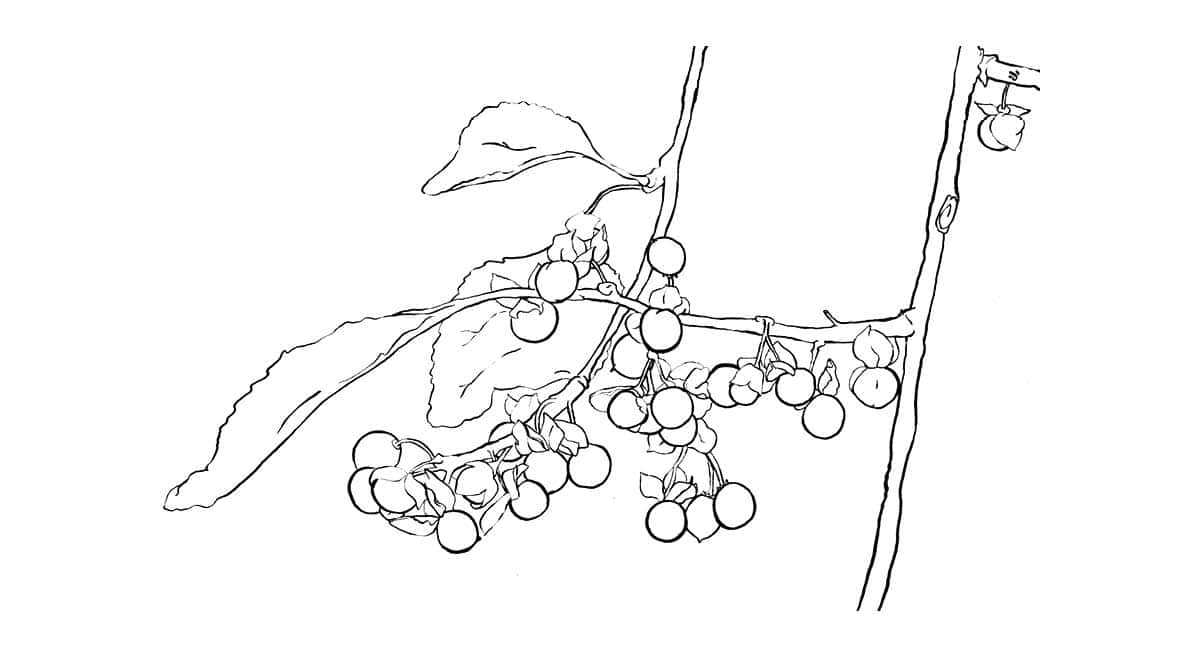
Our COVID-19 Activities Guide is chock-full of resources to help you keep learning and protecting our public lands. A recent addition is a series of coloring sheets featuring non-native invasive plants that you can print and color at home. Each sheet will have a short history on how that plant was introduced to our region and tips in identification and eradication.
Oriental Bittersweet
Update: We’ve just released our second coloring sheet, for Oriental Bittersweet. As a vine, the Oriental Bittersweet strangles trees and grows in both full sun and shade, making it a threat in any forest or suburban yard. It produces a prodigious annual seed crop which is eaten and spread. The fruits are often used in autumn wreath making, which furthers their spread.
Oriental bittersweet vines often appear spotted, and circle up anything they can climb. Its leaves are alternately arranged, and round with rounded teeth and usually a pointed tip. Its berries are bright orange-red which burst out of their yellow casing in the fall.
The first step for eradication is to cut this vine off of trees to prevent their being strangled and to bag and dispose of any berries. This vine responds well to chemical treatment, but can be pulled if done carefully and with follow ups each spring to check for new sprouts.
Download the pdf.
Multiflora Rose
The first of the series is the prickly Multiflora Rose. A native species of Japan, China and Korea, Multiflora Rose was introduced to North America as an ornamental rose that was once seen as an attractive living fence for livestock. Now we know it is an incredibly damaging invasive plant that has invaded our public lands. It spreads quickly (each plant can produce hundreds of thousands of seeds in a single season), forms dense, impenetrable thickets, and crowds out native plant species.
Like most roses, Multiflora Rose has green to red stems and compound leaves with delicately toothed leaflets. To differentiate from native roses, look for sharp, downward-hooked thorns, and “eyelashes” at the base of the leaves.
To get rid of them, Multiflora Rose can be dug out, or cut down as long as sprouts are pulled each spring. They also responds well to chemical treatment.
Download the pdf.
Thank you to Hendersonville native Sarah Ray for providing the art.