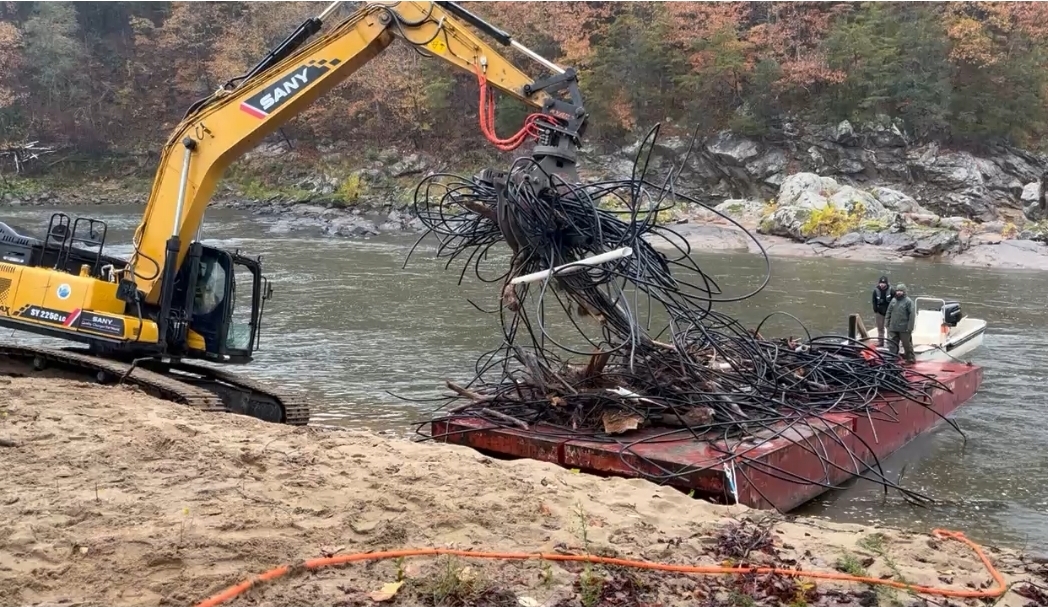
Like many who frequently paddle section 9 of the French Broad River, Jemima Filiss-Cook thought several of the giant debris piles deposited by Hurricane Helene would be permanent fixtures on the river’s most technical whitewater stretch. After Madison County’s’ contractors swept through the area picking up larger debris from Hurricane Helene, many mangled heaps of detritus remained, leaving Fliss-Cook to assume it would be easier to accept the eyesores than remove them.
That produced a sense of dread for Fliss-Cook, who was part of MountainTrue’s initial 11-member pilot river debris removal crew hired in March. She now leads MountainTrue’s Madison County River cleanup crew, a massive effort funded in part by grants from the N.C. Department of Environmental Quality and the Center for Disaster Philanthropy’s Truist Foundation Western NC Recovery and Resiliency Fund.
“Initially, I was feeling sick,” Jemima said about the debris piles near Sandy Bottom rapid in Madison County. “It felt like there was a permanence to it. And even if they weren’t permanent, extraction would be so overwhelmingly impactful that it would be like a secondary disaster for the river.”
However, after months of planning and coordination, MountainTrue completed cleanup of the six large piles of debris at Sandy Bottom in November, navigating Class III rapids and tricky river turns with the help of several property owners and a subcontractor hired to operate machinery.
“For us to be able to extract such sizable piles from such a tricky section of whitewater, improving paddler safety, and removing the biggest eyesores and reminders of the storm from one of the most heavily-recreated sections of river is huge,” says Jack Henderson, French Broad Paddle Trail Manager who led coordination for the removal project at Sandy Bottom. “More broadly, this represents a significant milestone in our recovery.”
The project
For 11 days spread over two-and-a-half weeks, with support from MountainTrue’s Madison County and Asheville-based River Debris Cleanup crews, Flowline Energy Services operated an excavator, rock-haul truck and barge, guided by MountainTrue jetboats, to remove thousands of pounds of debris. The exact amount is still not known, as the debris waits to be hauled to the landfill via railroad.
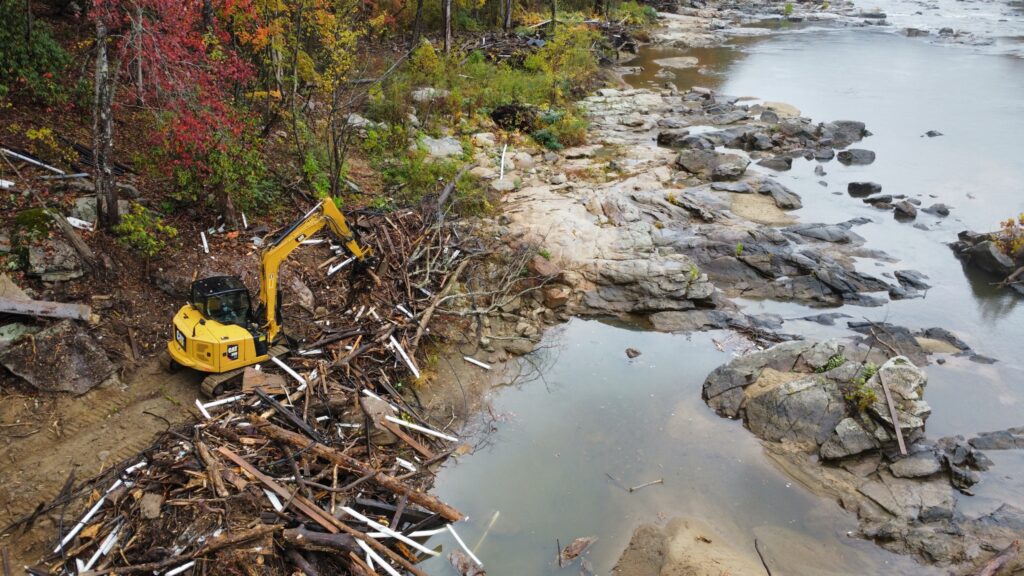
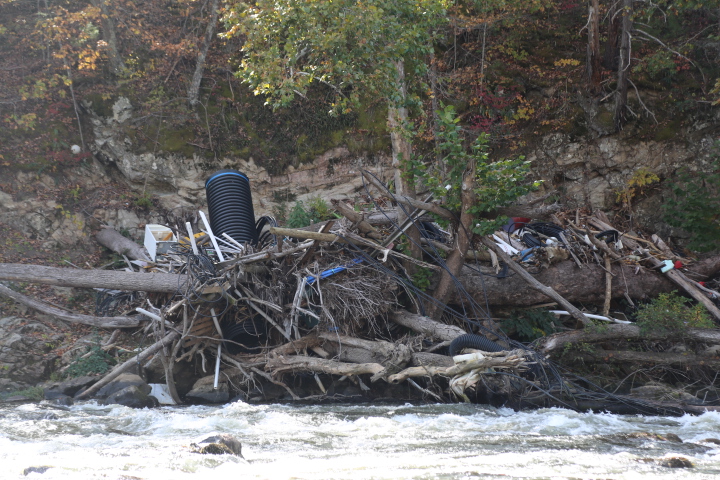
But it was significant. The piles included large amounts of plastic piping, construction debris, sheet metal, refrigerators, styrofoam, large culverts and more, all mangled together with woody debris and other organic matter, far more than could be tackled efficiently by hand.
Plus, the piles were hard to access. Putting aside the months of obtaining permits, wrangling a contractor willing to do things the right — and more difficult — way, and negotiating with private riverside landowners for access, the river is downright tricky at Sandy Bottom. There’s a tight turn with narrow passage around some large rocks where the most upstream pile was, and the whitewater doesn’t let up as you move downstream around more large boulders.
Additionally, all six piles were on the west side of the river, basically impossible to access by road, meaning the equipment would somehow need to cross the river while disturbing the riverbed as little as possible. It was the most challenging and technical job Flowline had ever done, the foreman said.

The crew, led by Jack and Jemima, was up to the challenge. To limit impacts, and because the water was a little too deep in part of the project area, it was decided that the contractor would bring in a barge to float the smaller excavator across to the west side of the river.
To Jack, it sounded great, but questions remained.
“How do we get the barge there? How does it operate in fast current? How does it not get stuck on rocks? What happens if it washes downstream? This is not the typical environment that they usually operate those things in,” he noted.
MountainTrue staff, intimately familiar with that section of river, were able to help shepherd the barge back and forth across the river with jet boats, greatly limiting contact between the heavy machinery and the riverbed.
“We managed to achieve zero substrate disturbance in the lower part of the project,” Jack added.
Equipment did have to enter the river in one narrow 25 foot-wide lane between French Broad Crossing’s River Park and the upstream-most pile at Sandy Bottom rapid. There, an excavator tracked across just twice, on two different days, and stayed on the western bank while loading the rock haul truck with debris. The rubber-tired truck drove back and forth in a narrow lane to dump debris in the park, where it was sorted by hand.
Flowline’s flexibility, creativity, and willingness to use any tool at their disposal to get the job done in the most ecologically sensitive way possible impressed Jack, who was intent on minimizing damage to wildlife habitat on the riverbottom.
Additionally, unlike with earlier work conducted after the storm by companies contracted by Madison County, MountainTrue and Flowline were able to leave the “vast majority” of the woody debris to decompose naturally on the shoreline in areas where it wouldn’t endanger paddlers.
Collaboration
The project is an example of a beautiful collaboration between MountainTrue staff, its contractor, property owners, regulators and river debris cleanup teams, Jack noted.
But none of it would have gotten off the ground without significant cooperation from property owners in the area, including Jay Hawthorne of French BroadCrossing, who helped coordinate access for MountainTrue to the HOA’s riverfront park near Sandy Bottom.
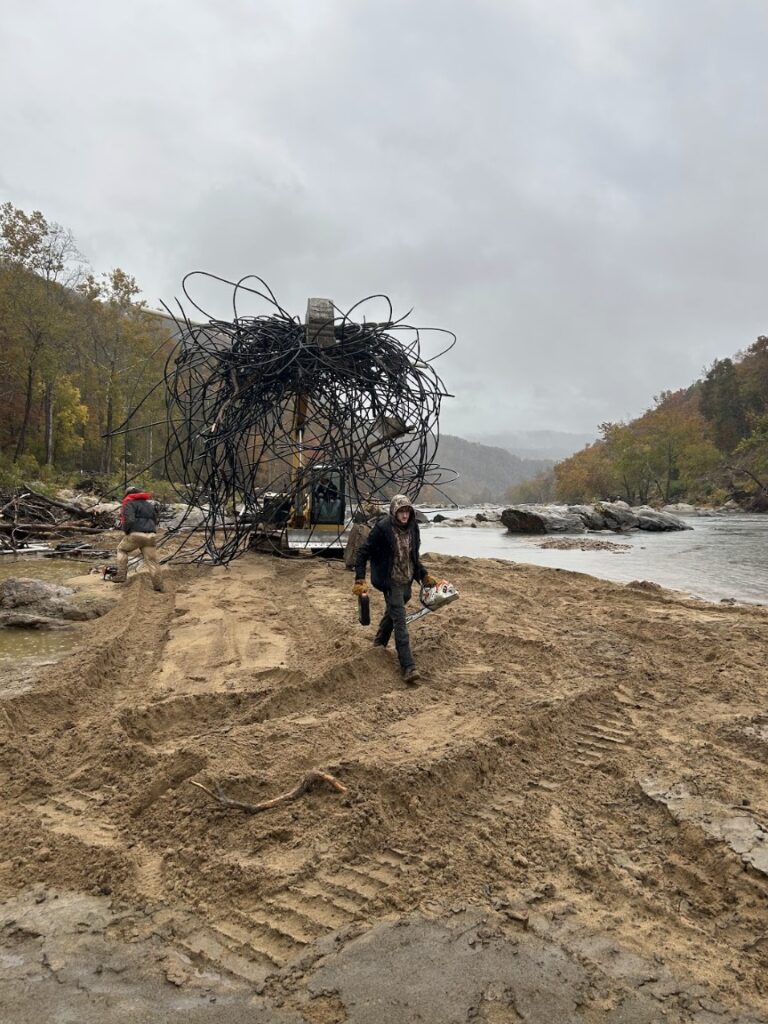
Also critical was Jemima’s work to convince the Treadway family, who own property on the west side of the river, to allow an excavator on their property.
“Having interested and present landowners to grant and facilitate entry, answer questions in real time, and provide access to additional services made things way easier and more realistic,” Jack said.
A co-owner of the Laurel River store that sits on the intersection of U.S. 25-70 and NC-208 near Hot Springs, Jemima’s deep Madison County roots earned the trust of stakeholders near Sandy Bottom, all of whom wanted to see the debris removed.
“It’s a major confidence booster for MountainTrue to have success in a complicated project like this,” Jemima noted.
Jack also led the effort to contact regulators and receive the appropriate permits, a monthslong project of its own that shows it doesn’t necessarily take a large agency to coordinate a complicated removal project.
“A nonprofit like ours, with the collective expertise and interest in the river’s health, has the ability to project manage something like this. It’s a testament to our ability to get the job done right.”
The project’s success has boosted morale among the River Debris Cleanup Teams.
“We might be able to do this, it might be successful,” Jemima reflected of MountainTrue’s goals after the project’s completion. “It’s starting to make our goal of cleaning up all of this debris feel doable after all.”
Calling riverside landowners
Hopefully, Jack said, this can serve as a positive model for project management of waterway debris removal from Helene to future disasters.
As MountainTrue’s river debris removal project continues, organizers are looking for opportunities to collaborate with more private property owners across the region.
Whether there is Helene-related debris in a river that flows through or adjacent to your property, or you would be willing to grant MountainTrue access to a river through your property in an area where debris remains, the river debris removal team would like to hear from you. Simply fill out this form and we will be in touch.