Written by MountainTrue Debris Removal Story Collector Liz McGuirl
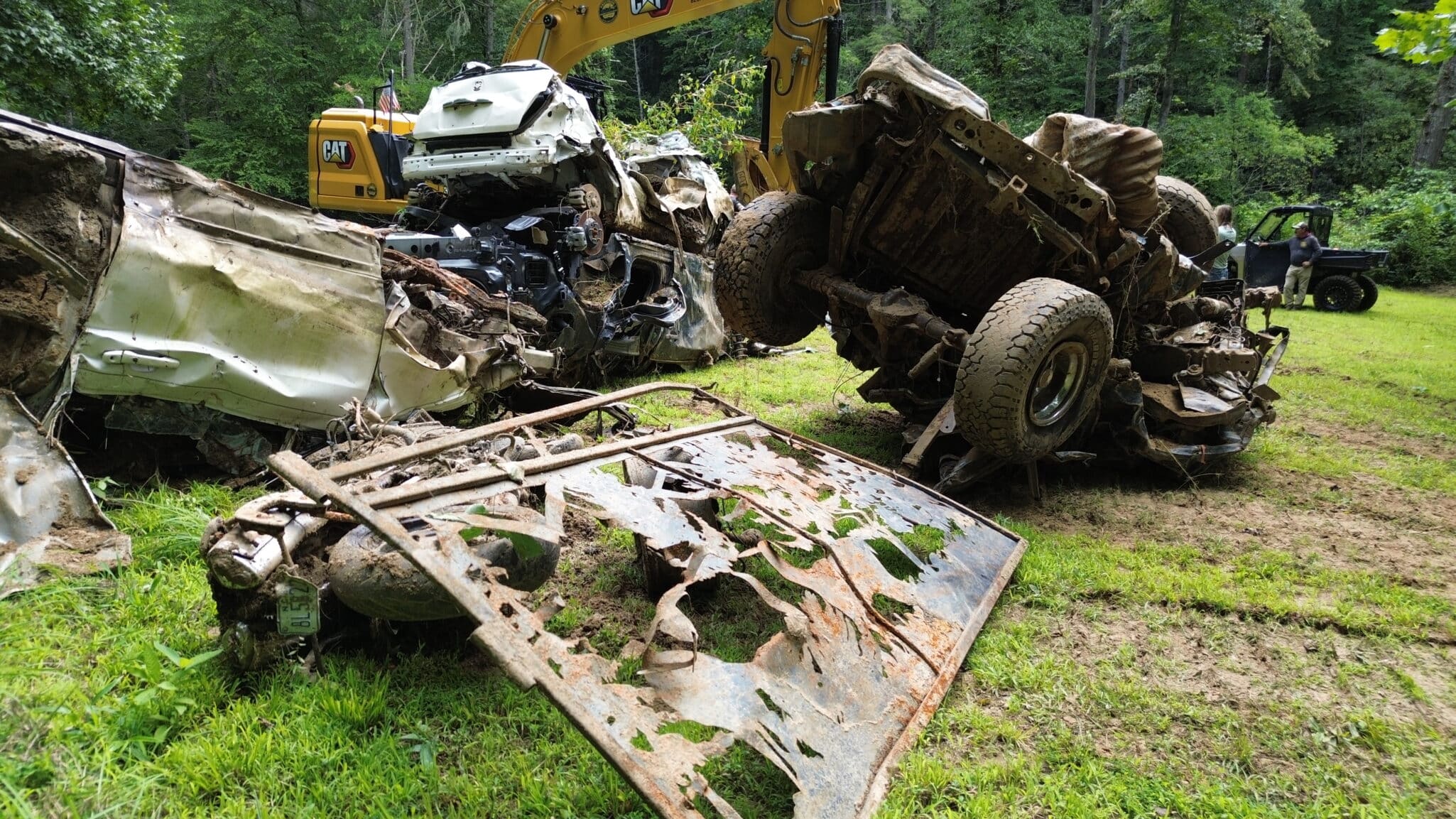
It takes a village — and lots of time — to clean up mountain rivers after a storm as significant as Hurricane Helene. Earlier in August, nearly twenty-three months after the generational storm, MountainTrue and its partners removed four cars and one motorcycle from the Big Hungry River in Henderson County.
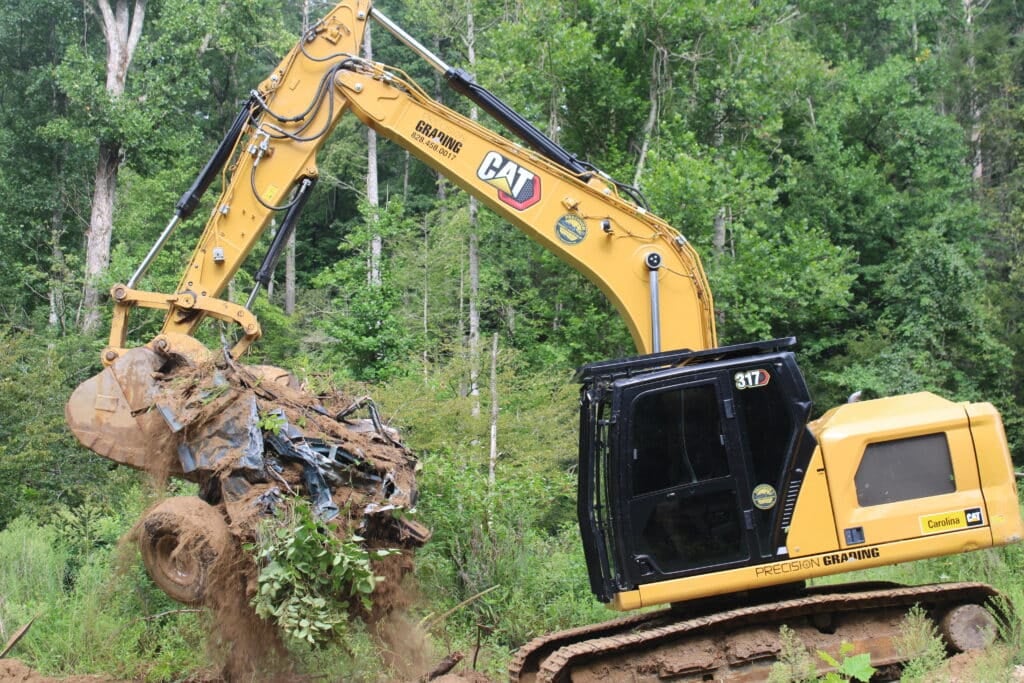
Using an excavator and all-terrain vehicle, Jake Jarvis of Saluda-based Precision Grading traversed a windy, rough ATV trail, several creek crossings and at least one copperhead snake den to pull vehicles out of the rugged, remote tributary of the Green River.
“It’s crazy to still be pulling cars out, you know, almost two years later,” said Jarvis, who has worked tirelessly since the storm to remove hundreds of thousands of pounds of large debris using his grading equipment.
While our debris crews have been working tirelessly over the last year to remove millions of pounds of debris from our WNC waterways post-Helene, our work simply would not be possible if it weren’t for the help of SO many neighbors, partners, local organizations, and contractors. Using a tip from one neighbor, property access from another neighbor, state and private funding, MountainTrue crews scouted the site, planned the vehicle removals, and contracted Precision Grading to execute the project.
“I think this whole time after the hurricane, what we’re noticing is that this is not just a one person or a one organization effort. This is community members, other partner organizations; it’s local contractors, and it’s our teams coming together to tell us where things [debris] are. It takes a village to continue this work.”
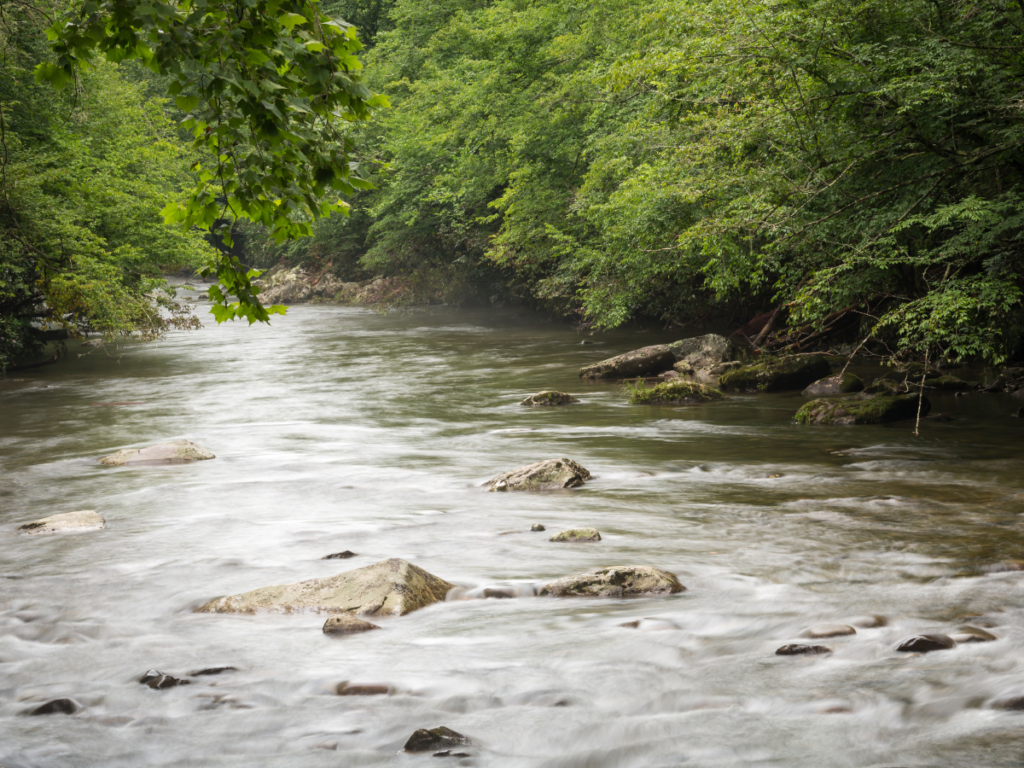
This remote stretch of the Big Hungry River flows into the Green River within the Green River Game Lands and features lush wilderness, scenic cliffs, secret coves, and steep terrain.
Earlier this year, Erica and “Green Bats” Debris Crew Leader Jordan McDaniel scouted the area, revealing that a number of vehicles had been deposited along a curvy stretch of the Big Hungry River by floodwaters. All of the vehicles were found partially submerged in the river or buried along its sandy, silty banks. Additionally, all of the vehicles were pinned against or between large trees that washed downstream during Helene, prompting Erica to schedule a follow-up scouting mission with MountainTrue’s River Cleanup Operations Director and the chainsaw-adept Technical Crew to determine the best way to tackle removal.
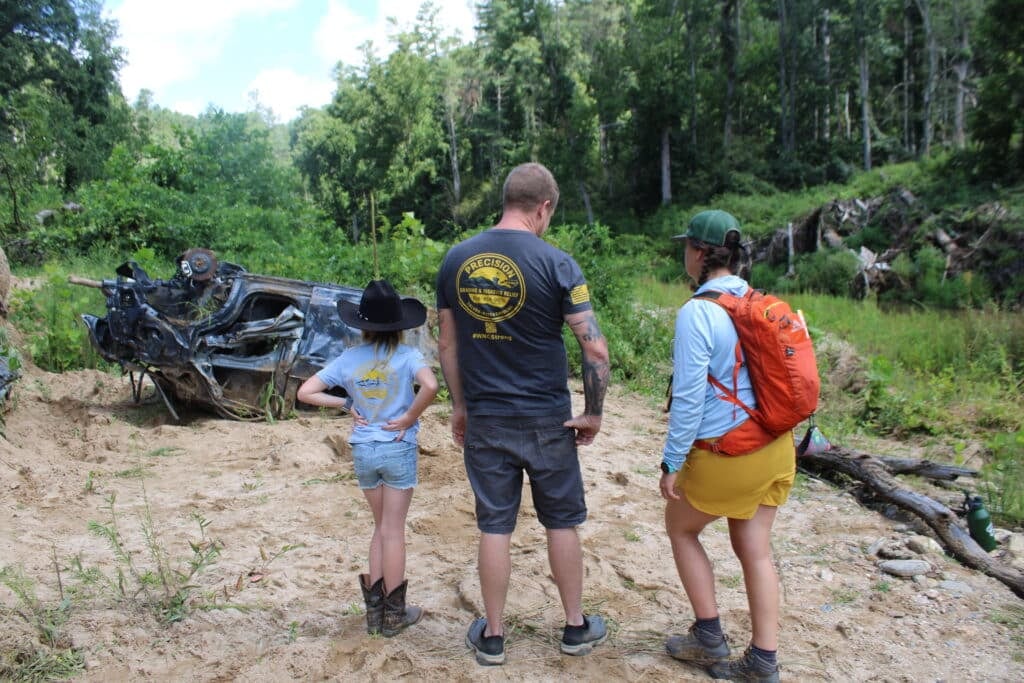
Before long, Erica was alerted to an additional car and motorcycle discovered by a neighbor along that same stretch of river, but on private property. While grateful for the information, for Erica, the alert was a reminder that there are so many hard-to-reach waterways, often surrounded by private property, that could remain untouched by debris removal efforts.
“This is a prime example of, it’s almost two years past the hurricane, and we wouldn’t have known about these cars in the river if it weren’t for our community alerting us. And I think that says something… because now we’re wondering, ‘where are there other places where this might be [the case] that we don’t know of?’” Erica says.
Her initial thoughts and reactions showed just how integral a role community members play in helping us to recover and restore our waterways in the aftermath of disaster. Landowner Eric Smith, who has lived in the Green River Cove for nine years, played an important role, allowing MountainTrue to access the river through his riverside property.
“Right after the storm… there’s a bend in the river, so everything got swirled and deposited right in our field. There’s four foot banks of sand and we have about an acre down there. Everyone’s tools and personal belongings from upstream came down,” Eric noted.
In the aftermath of the storm, Eric and his neighbors had done their best to clean up down along the river, but realized that the scope of debris removal necessary was far beyond what they could achieve without equipment.
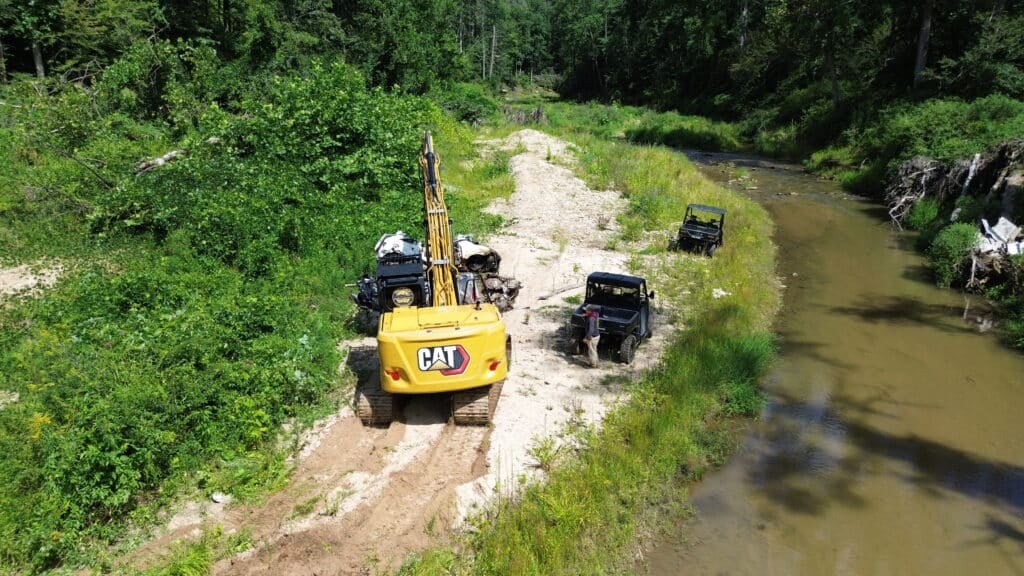
The project: Removing 4 cars, 1 motorcycle, 1 metal culvert, and 1 large pile of metal and other assorted household debris from the river
“I think this whole time after the hurricane, what we’re noticing is that this is not just a one person or a one organization effort. This is community members, other partner organizations; it’s local contractors, and it’s our teams coming together to tell us where things [debris] are. It takes a village to continue this work.” – Green Riverkeeper Erica Shanks
Already well-acquainted with one another — having completed various large-scale debris removal projects on the Lower Green River in the initial months after Helene — Saluda-based contractor Jake Jarvis was Erica’s natural first choice for this project. His firsthand knowledge of local land and water combined with his knowledge, skills, and expertise in operating machinery to remove debris from remote stretches of river has positioned him as an invaluable partner to MountainTrue for some of the larger debris extraction projects in Henderson and Polk counties.
While it is never ideal to have heavy machinery driving through our waterways, Jake’s conscientious approach to this kind of work makes him a good partner for MountainTrue. He uses low ground pressure machines equipped with eco-safe fluids to mitigate additional damage from his machinery on our waterways.
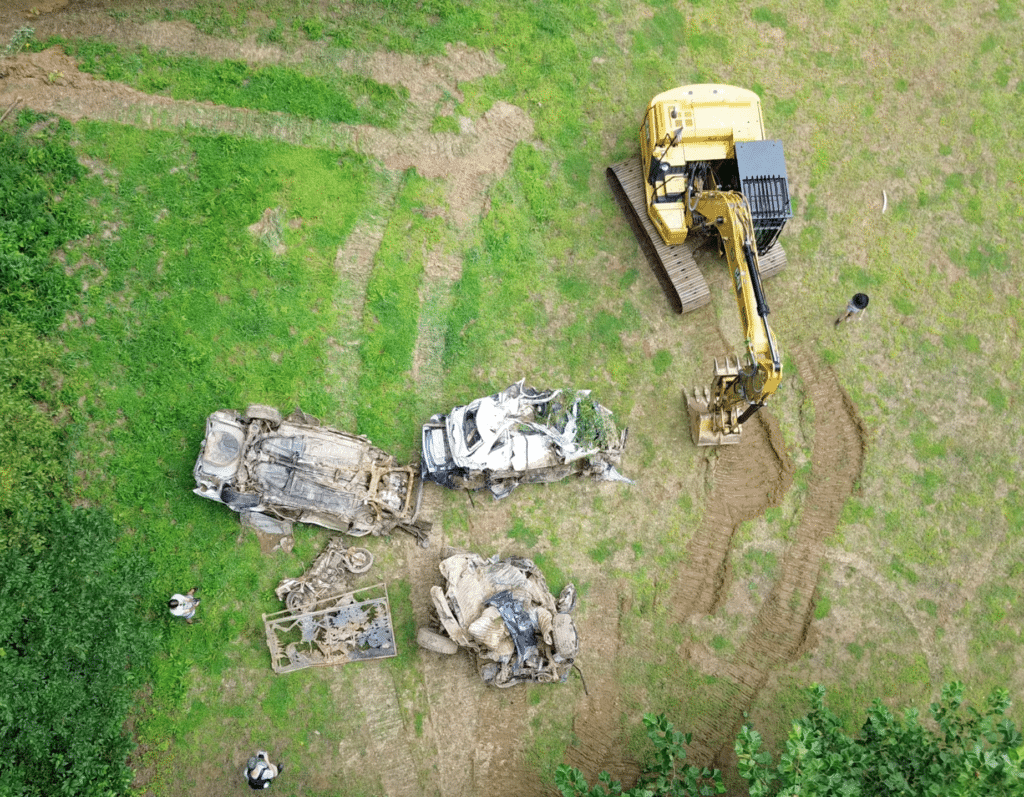
Within a few hours, Jake was able to successfully remove all four vehicles, the motorcycle, and the metal culvert from the sandy river banks and haul them out of the cove to a designated staging area. Often carrying two vehicles at a time within the claw of his excavator, Jake slowly climbed his way back up the (over a mile long) forested access path that winds through Eric’s property, before finally being able to haul them away from the cove.
“It’s crazy to still be pulling cars out, you know, almost two years later” – Jake Jarvis, Precision Grading
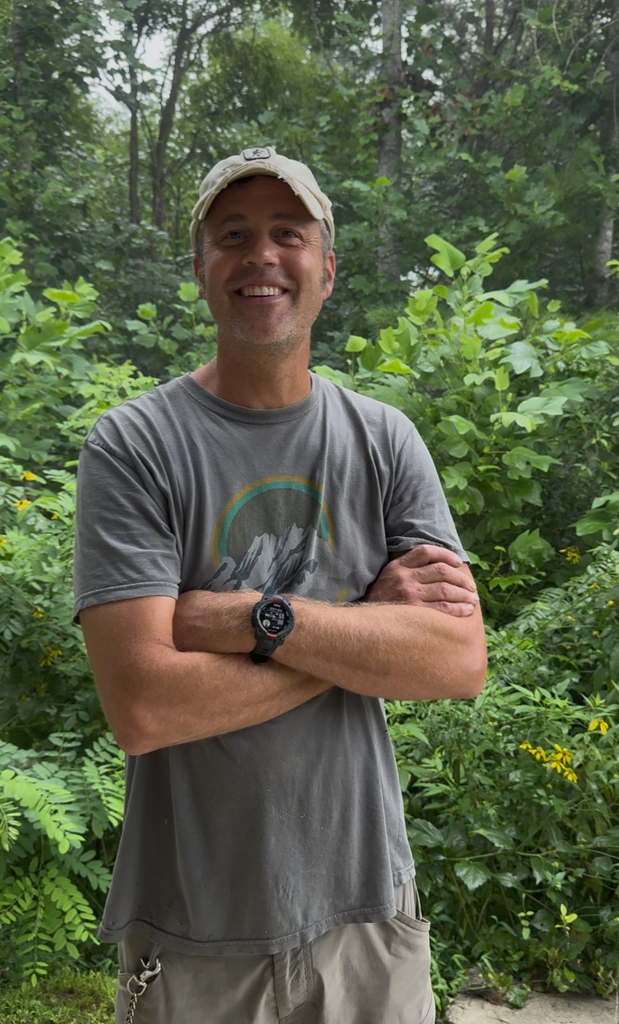
“This is a big deal” – Eric Smith, landowner
Erica and Jake, with the help of his daughter Mya and MountainTrue’s Green Bats debris crew, worked together to find the vehicle identification numbers (VINs) for each of the vehicles that were recovered. Erica hopes to be able to get in touch with the owners and provide them with some closure, knowing that some of what was lost in the storm has finally been recovered.
“Removing these cars from the river and streambank isn’t just to clean the river. This work is to connect a community back to what was lost and be another step in processing this catastrophic event,” Erica says.
“This is a big deal,” Eric (landowner) told us the morning the cars came out. “Natural events happen, and there’s only so much that local people can do. I don’t have the resources to go down there and [remove these cars], so it means a lot. Not just for me, but for the people that use the river, like kayakers and tubers, fishermen and hunters. It’s nice to have it clean.”
The debris removal work is FAR from over. We still need all the help we can get — if you see large debris in our WNC waterways, please reach out and alert your local riverkeeper. For riverside landowners who need help removing debris from their property, reach out using this form.
The project represents the type of work still needed throughout the region. In the last year, since MountainTrue received a $10 million grant from the N.C. Department of Environmental Quality, our debris crews have removed 2.5 million pounds of Helene debris from 742 miles of WNC waterways. Since the storm, MountainTrue has removed a cumulative amount of 5.5 million pounds of debris, and intends to continue cleaning up until the last piece of debris — and the last vehicle — has been removed from our rivers.