BANFF Tickets on Sale Now
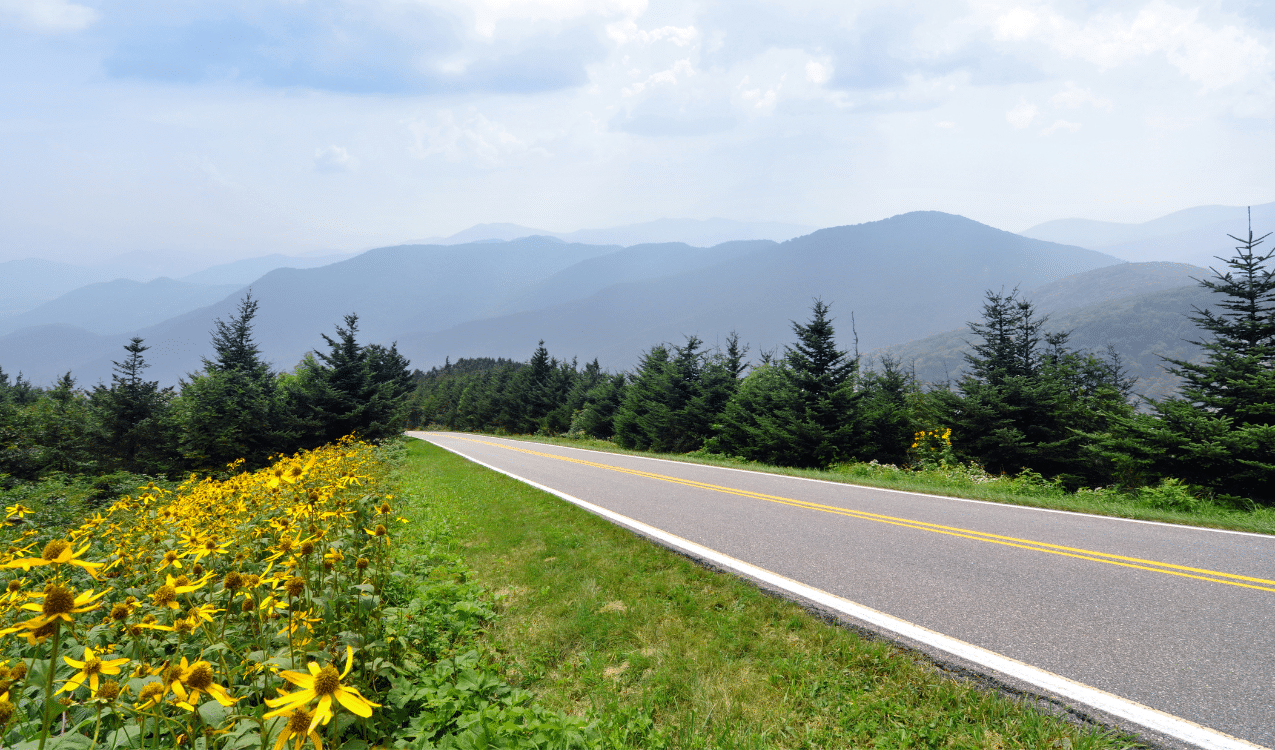
The National Park Service held three open house meetings last week where they unveiled plans for a 3,000-acre fuel reduction project. Hundreds of members of the public learned at these meetings that heavy equipment will be used to remove downed trees from up to 58 areas identified through a combination of remote sensing and on-the-ground reports. Logging roads and log landings, flat areas where logs are stacked before loading onto trucks — often over 5,000 square feet — will be graded into hillsides. The intention of the Park Service is to return the land to contour after grading with heavy equipment, but it’s hard to see how that level of disturbance can be put back right. It’s also hard to see how such a heavy-handed project complies with the core Park Service mission.
Key points from the open house meetings:
More information:
Helene blew down vast swaths of forest on its march across the southeast. The scale of the blowdown in the Southern Appalachians is without precedent in the historical record, yet storm damage in forests is not only normal, it is also necessary. It is shocking and heartwrenching to see a forest you love blown down, but forests have and will recover from storms. In developed areas, removal of down debris is wise, but in our natural areas, dead and down trees provide habitat for a myriad of birds, mammals, salamanders, and insects while the abundant sunlight quickly grows the next generation of trees. Despite down trees providing excellent habitat for numerous wildlife and enriching the soil, the National Park Service is proposing to remove nearly 3,000 acres of trees along the Blue Ridge Parkway. Some of this ground is near houses, but some areas are up to 1,200’ from the nearest structure. They are calling this “fuel reduction,” but the methods will be indistinguishable from salvage logging. Some of the areas subject to fuel reduction will be the entire section of Parkway between the French Broad River and Elk Mountain Road in Buncombe County, the vicinity of Crabtree Falls, and Moses H. Cone Park near Boone.
Despite concerns about honoring the National Park Service’s mission to preserve parks for future generations, there are also valid concerns about fire danger due to down trees. Those concerns are especially salient within 100’ of homes, according to wildfire experts at the US Forest Service and Cal Fire. While removing down wood near homes is well supported, the idea that down trees deep in the mountains still cause a risk is based more on emotion than facts. There is a strong desire to do something, or anything, following a natural disaster to speed recovery. And the National Park Service and the US Forest Service have literally billions of dollars of FEMA money to spend. However, remote storm damage does not threaten humans, nor does it threaten the forest. In fact, the conservation community in general agrees that our forests need more fire, not less. Furthermore, while wildfires can be scary, there are very few examples of a “bad” fire in the Appalachians from an ecological standpoint, and most of those, like the famous fire at Graveyard Fields, occurred after logging.
Some of the work to remove fuels on the Parkway may be necessary where people have built their houses within 100’ of the park boundary. We’ll leave the discussion about why the public has to bail out homeowners who build right next to a national park for another time. Some work to remove down wood near the road itself will create a defensible fire break. Fuel reduction that involves heavy equipment that is farther than 100’ from the Parkway or 100’ from structures will be taxpayer-subsidized make-work.
If wasted money was all that was at stake, that would be one thing, but some of our region’s natural treasures are also in the crosshairs. For example, the stretch of the Blue Ridge Parkway between Craven Gap and Elk Mountain Road is well known as a biodiversity hotspot and has been recognized as the Bull Gap/High Swan Natural Area since the late 1970’s. Over a dozen rare plant species and North Carolina’s largest population of Cerulean Warbler call this area home. Heavy equipment will damage plant populations, drive out nesting songbirds, and compact the rich soil that supports the entire ecosystem. Any fuel reduction in this area, and dozens of other sensitive spots along the Parkway, should be done with the utmost care to minimize disturbance to natural habitats. The Parkway has the money necessary to do this project with the lightest possible touch. In this case that probably means using a helicopter rather than bulldozing in roads and log landings.
Please ask your elected officials to: (stay tuned for an updated Action Alert from our team that will be linked here!)
References: